
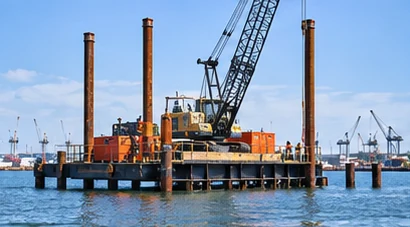
Marine Operations
Map vessels, crews, docks and work locations. Clarify insured roles, project jurisdiction, indemnity and specialty coverages with qualified advisers. Analyze collision, injury and pollution scenarios separately. Assess the policy and commercial evidence needed at each project.
Mining and Heavy Equipment
Distinguish mobile equipment, haul roads, processing facilities, contractors and locations. Map concentration of expensive machinery and recovery time. Test severe injury and interruption scenarios. Review data by operation, site and valuation date. Equipment-intensive programs can benefit from separating repeated operational risks from plausible site-wide events.
Government Contractor Operations
Review prime and subcontract requirements, place of performance and mandatory lines. Contract terms and statutory obligations can differ between domestic, overseas and maritime work. Seek advice on coverage, reimbursement mechanics and carrier requirements early in the procurement process.
Build a Project-Level Comparison
Separate contract risk, coverage, proposed financial retention and claim administration. Obtain professional input where jurisdiction or line authority is uncertain. Carry special lines and project-specific arrangements explicitly in the comparison instead of assuming broad casualty placement covers them.

Segment the Portfolio by the Legal Basis of the Work
A company can perform repair at a waterfront terminal, mobilize earth-moving equipment to a mineral site and accept a federally funded assignment under different contracting entities. Insuring all three under the same loss-financing arrangement can hide important policy, jurisdiction and claims administration differences. For each assignment, document the employer, place of performance, customer, equipment control, workers’ tasks, financing restrictions and applicable contract clauses. Identify coverage that contracts or authorities require independently of what the captive can assume. Keep a project-level schedule of limits, coverage evidence and who handles claims under each distinct placement.
| Assignment | Review first | Evidence to request |
|---|---|---|
| Marine repair or loading | Status and location of workers, vessel interest and charter terms | Crew and labor roster, vessel contract, waterfront footprint and endorsements |
| Mine haulage or process services | Mine jurisdiction, equipment ownership and site duties | Operator and contractor records, asset list, work boundaries and incident history |
| Federal or overseas performance | Contract clauses, place of performance and subcontract flowdowns | Prime and subcontract extracts, declarations, evidence of required authorization |
Analyze Waterfront Work by Role and Location
A company may own a workboat, charter equipment or send employees to maintain another party’s vessel. Who qualifies as maritime personnel, which federal or state workers’ protections apply and which operator or insurer can respond are separate questions. For covered Longshore and Harbor Workers’ Compensation Act employments, review the statutory requirement to secure compensation through an authorized insurer or authorization to self-insure. Employee duties, location and statutory definitions can affect applicability. Have specialist counsel and a broker analyze the exact workforce and project before treating a state workers’ compensation policy or a captive’s economic participation as meeting a federal obligation.
For a hypothetical crane or workboat incident, injured workers, damaged property and alleged discharge can arise simultaneously. The owner may claim damage to its vessel or barge, the charterer may assert an indemnity and a third party may incur cleanup costs. Check if the event implicates vessel hull, protection and indemnity, marine general liability or pollution terms. Examine insured status by role, towage or charter terms, exclusions and both primary and excess notices. Keep recoveries from third parties separate from gross expenses in the budget. An executed charter or service agreement is essential to the issue map.
Evaluate Mine Site Control and Equipment Downside
Ask whether the enterprise acts as mine operator, independent contractor or both, and identify activities at each site. Where mine safety reporting applies, reconcile the operator’s and contractor’s records with MSHA requirements, including the applicable Part 50 accident, injury and illness reporting framework. Regulatory records and claims records can use different definitions. Match dates and exposure bases and investigate apparent discrepancies before incorporating them into estimates. Check how moves between sites or subcontract arrangements affect responsibility for scheduled equipment, employee injuries, vehicle movement and notifications.
Equipment concentration deserves separate treatment from frequency in general liability or injury. A failed crusher, disabled haul road or damage to several rented units may stop production even where no one is injured. Analyze replacement and rental availability, repairs, transportation cost and substitute capacity. Compare contractual charges for loss of use or delayed production to actual insurance terms. Verify whether operators, lenders or lessors require proof of coverage independent of the proposed deductible or captive layer. Ask how coverage terms would respond to a unit moving between a controlled site and a public road and how the transition is recorded.
Review Federal Coverage and Subcontracts Before Mobilization
Where the Defense Base Act applies, legal and insurance specialists should check the work, location, employer obligations, authorization and any applicable waiver or exception before deployment. FAR 52.228-3, when incorporated, requires the contractor to secure and maintain the specified workers’ compensation insurance or self-insurance approval and addresses subcontract flowdowns when DBA coverage is required. Other insurance clauses, endorsements or overseas obligations can also apply. Trace requirements to the awarded contract and modifications. Keep carrier acceptability and eligibility evidence separate from premium allocations or cost-reimbursement analysis.
For a remote government assignment, document which party arranges emergency medical support, who receives injury notices and how claims are transferred across locations. Treat transportation, liability, equipment damage and other overseas exposures separately from DBA benefits. A program proposed for domestic casualty may rely on claim handlers, approved insurer paper and reporting processes that differ overseas. Contract performance can depend on producing evidence before travel and maintaining it through demobilization and later claims handling.
Run a Concurrent-Projects Liquidity Case
A hypothetical contractor expects to pay $125,000 on the retained portion of a covered mine incident and expects $175,000 in uninsured or disputed emergency marine costs in the same month. Separate government mobilization requires $640,000 of working cash, and revised security consumes a further $160,000 in credit capacity. Model $1.1 million of combined near-term pressure on resources, with each outflow categorized and potential recoveries shown on a separate timeline. This example does not estimate actual coverage. Track which payments can be delayed, which are mandated and which use a facility rather than cash, then compare the result with unencumbered liquidity and financing covenants.
Require a decision by segment rather than signing a single portfolio assumption. Ask which entity can finance each retained layer, who can post security and whose contracts limit eligible providers. Check any restrictions on sharing risk across related entities or member categories. Define escalation when a client scope, wage base, mine assignment, vessel use or country of performance changes. A contractor with strong domestic loss history may still require separate transfer for maritime, overseas or equipment accumulation risk. Keeping those distinctions visible helps the executive team control insurance costs without accidentally creating a contract performance gap.
References
Sources reviewed November 27, 2026.
Educational information for commercial insurance discussions. Review actual policies, agreements and applicable requirements with qualified insurance, legal, tax and actuarial advisers.